
Decision Guide
DIY vs. Professional Water Removal: When Is a Shop-Vac Enough?
DIY vs professional water removal: when a shop-vac, fan, and dehumidifier are enough for a wet basement, when they aren't, and what professional equipment does differently.
DIY water removal is usually enough for a small amount of clean water on bare concrete or tile, caught within hours, with nothing porous soaked. Call a professional when water soaked carpet or drywall, came through a floor drain, covers more than a small area, or sat for more than about a day, because hidden moisture is what grows mold.
Published 2026-09-26 · Updated 2026-09-26
Water Damage Lansing is a water damage restoration company in Lansing, MI, and we’d rather tell you when you don’t need us. Here’s an honest look at DIY vs. professional water removal for a wet basement.
When DIY is usually enough
All of these should be true:
- The water is clean: a supply line, water heater, or washer fill hose, not a floor drain, sewer, or floodwater.
- It’s on bare concrete, tile, or sealed flooring, with no carpet, pad, or drywall soaked.
- It covers a small area, and you caught it within hours.
- You can get it dry within 24–48 hours.
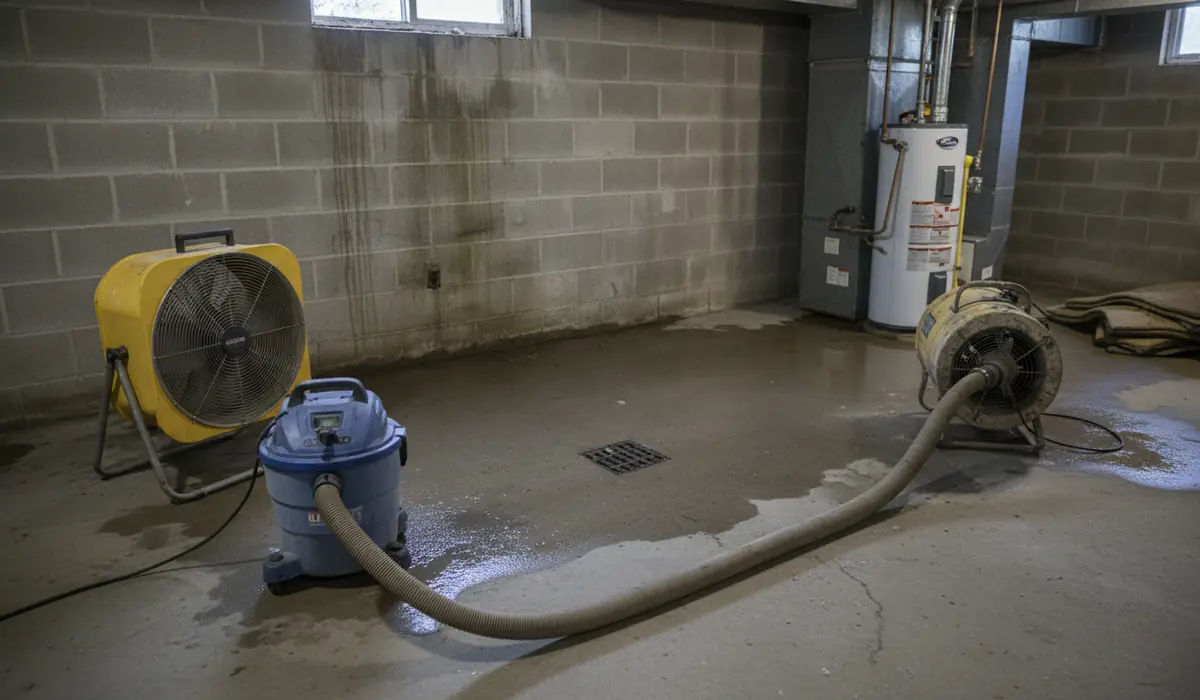
DIY kit: a wet/dry vac (on a GFCI outlet, never standing in water), a squeegee toward the floor drain, a dehumidifier running with the basement closed off, and a fan or two. Check it again in two days: if it smells musty or anything still feels damp, you have hidden moisture.
When to call a professional
- Water came up through the floor drain. That’s Category 3 sewage. See is sewage backup dangerous.
- Carpet and pad are soaked. A shop-vac can’t pull water out of pad sitting on cold concrete.
- Drywall or paneling got wet. Water wicks up inside walls where you can’t see or reach it.
- More than a small area, or more than an inch or two of standing water.
- It sat more than a day. Mold can start within 24–48 hours.
- You’re filing an insurance claim. Adjusters want moisture logs and photos.
What professional equipment does differently
| DIY | Professional | |
|---|---|---|
| Water removal | Shop-vac: surface water | Pumps plus truck-mount or weighted extraction that squeezes water out of carpet and pad |
| Drying | Home dehumidifier and box fans | Low-grain refrigerant dehumidifiers and air movers sized to the space |
| Finding hidden water | Touch and smell | Moisture meters and a mapped dry standard |
| Walls | Wait and hope | Flood cuts or cavity drying where readings are high |
| Knowing it’s done | Looks dry | Readings match unaffected materials |
Why Lansing basements are harder
Greater Lansing’s clay soil stays saturated after rain and snowmelt and keeps pushing moisture into foundations, and basements are cool, which slows drying. Published Lansing timelines put a professionally dried basement at 4–5 days. Without dehumidification, it can stay damp far longer. See how long to dry out a basement.
The honest middle ground
If you’re not sure, call and describe it. If a shop-vac and a dehumidifier will do the job, we’ll tell you.
The bottom line
If you want this priced for your own property rather than in ranges, we come out and assess at no charge across Lansing and the Greater Lansing area — including East Lansing, Okemos, Holt, DeWitt, Grand Ledge, Delta Township, and Haslett. You get a written scope with the water category and affected areas broken out separately. Call (517) 816-1499.