
Decision Guide
Can Wet Basement Carpet Be Saved, or Does It Have to Come Out?
Can wet basement carpet be saved? It depends on the water category and how long it sat. Rules for carpet, pad, drywall, paneling, and insulation after a Lansing basement floods.
Wet basement carpet can often be saved if the water was clean and drying started within about 24–48 hours. The pad underneath is usually replaced. After a sewer backup or floodwater (Category 3), carpet, pad, drywall, and insulation the water touched should come out. Drywall that is firm and only slightly wet can often be dried in place.
Published 2026-09-26 · Updated 2026-09-26
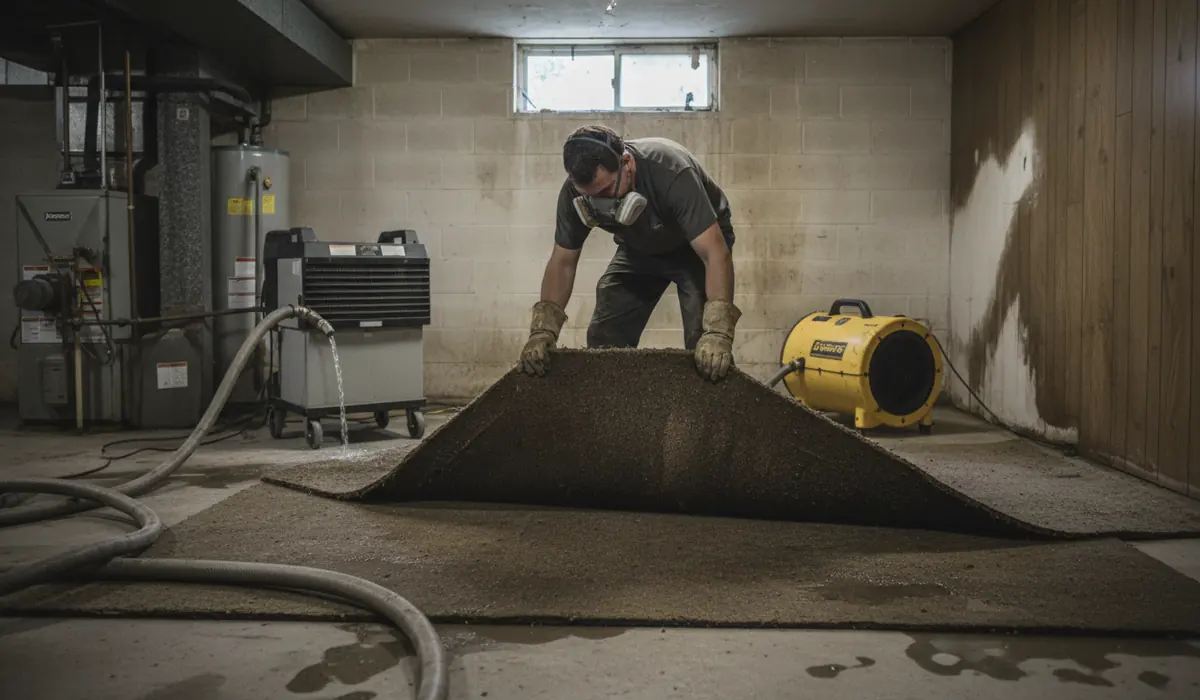
Water Damage Lansing is a water damage restoration company in Lansing, MI, where finished basements are the norm. So whether wet basement carpet can be saved, and whether the drywall can too, matters on almost every job. Two things decide it: what kind of water and how long it sat.
The quick rules
| Material | Clean water, dried fast | Sewage or floodwater |
|---|---|---|
| Carpet | Often saved: lifted, dried, re-laid | Removed |
| Carpet pad | Usually replaced | Removed |
| Drywall, firm and slightly wet | Often dried in place | Cut out above the wet line |
| Drywall, soft or wicked high | Flood cut | Cut out |
| Fiberglass insulation in walls | Usually removed | Removed |
| Paneling on block walls | Usually removed to dry behind | Removed |
| Concrete floor, block walls | Cleaned and dried | Cleaned, disinfected, dried |
| Solid wood framing | Dried | Cleaned, disinfected, dried |
The IICRC S500 standard is the basis: porous materials contaminated by Category 3 water, meaning sewage, floor-drain backups, and floodwater, are removed rather than dried.
Carpet and pad
Carpet itself is fairly tough. After a clean-water leak caught within a day or so, it can usually be pulled back, the soaked pad removed, the floor dried, and the carpet re-laid over new pad. Carpet with glued-down or foam-backed construction, or carpet that sat wet for days, is harder to save. After a backup or flood, carpet goes. There’s no reliable way to disinfect sewage out of carpet fibers and backing.
Drywall
Drywall wicks water upward. We check it with moisture meters, not by looking:
- Firm, slightly wet, clean water: can often be dried in place with air movers, sometimes by drilling small holes behind the baseboard to vent the cavity.
- Soft, crumbling, or wicked high: a flood cut removes the bottom 12–24 inches above the wet line, so the cavity and bottom plate dry.
- Any Category 3 contact: cut out.
Paneling and insulation
Paneling over furring strips on a block wall is common in Lansing basements, and it traps water against the block where nothing can dry it. It usually comes off. Wet fiberglass insulation holds water against framing and loses its value, so it comes out.
Time is the deciding factor
Mold can start within 24–48 hours. Clean water that sits also degrades toward a dirtier category. The faster drying starts, the more you keep. See how fast mold grows.
Photograph before anything goes
Before carpet, drywall, or belongings leave the house, photograph them for your insurer. See what to photograph.
The bottom line
If you want this priced for your own property rather than in ranges, we come out and assess at no charge across Lansing and the Greater Lansing area — including East Lansing, Okemos, Holt, DeWitt, Grand Ledge, Delta Township, and Haslett. You get a written scope with the water category and affected areas broken out separately. Call (517) 816-1499.