
Learn
How Long Does It Take to Dry Out a Basement?
How long to dry out a basement after flooding: typical days by water category, why Lansing basements dry slowly, what speeds it up, and how to know it's actually dry.
A professionally dried basement typically takes 4–5 days for clean water, according to published Lansing timelines, and 5–7 days or more after a sewage backup, because contaminated materials are removed first. Without dehumidifiers, a basement can stay damp for weeks. It's dry when moisture readings match unaffected materials, not when it looks dry.
Published 2026-09-26 · Updated 2026-09-26
Water Damage Lansing is a water damage restoration company in Lansing, MI. How long it takes to dry out a basement is usually the second question we get, right after cost. The honest answer is days, not hours, and longer here than in many places.
Typical drying times
Published Lansing timelines from Laurentian Restoration:
| Job | Typical drying time |
|---|---|
| Clean water (Category 1), general | 3–4 days |
| Clean water, basement | 4–5 days |
| Sewage or floodwater (Category 3) | 5–7 days |
| Category 3 with full biohazard protocol | 8–12 days |
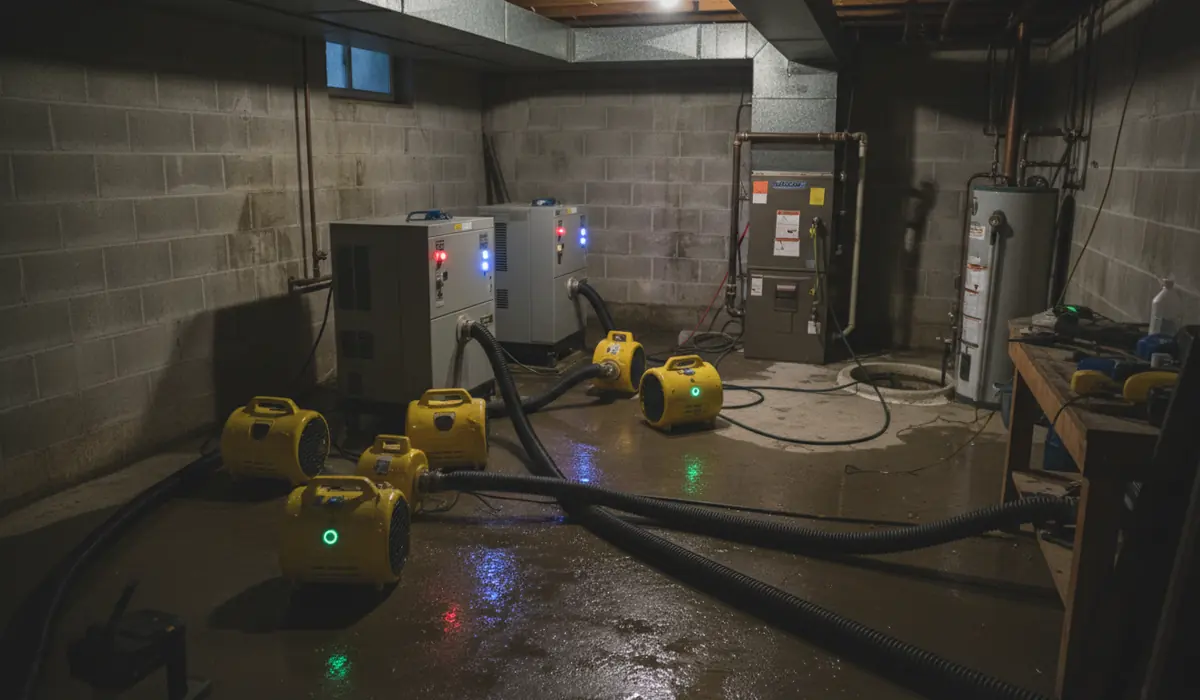
Those times assume professional extraction, air movers, and dehumidifiers running around the clock. Left to air-dry, a basement can stay damp for weeks, well past the 24–48 hours mold needs.
Why Lansing basements dry slowly
- Concrete holds water. Slabs and block walls absorb a lot and release it slowly.
- It’s cool down there. Cooler air slows evaporation.
- The clay soil keeps feeding it. Greater Lansing’s clay loam stays saturated after rain and snowmelt and pushes moisture back through the foundation.
- Finished basements hide water behind drywall, paneling, and carpet.
- Humid seasons. Spring and summer air is already damp.
What speeds it up
- Extract first, thoroughly. Every gallon pulled out as liquid is one the dehumidifier doesn’t have to remove.
- Remove what won’t dry: soaked carpet pad, wet insulation, and drywall that has wicked high. A flood cut 12–24 inches above the wet line opens the wall cavity.
- Use dehumidifiers sized to the space, with the basement closed off from the rest of the house.
- Move air across wet surfaces with air movers aimed at walls and floors.
- Get stored items out so surfaces can dry.
How to know it’s actually dry
“Looks dry” isn’t dry. Drywall and the bottom plates of walls can read wet for days after the surface feels dry. We take a reading from the same material in an unaffected area, which sets the dry standard, and keep drying until the wet areas match. Equipment comes out then. Closing up walls or re-laying carpet too early is how a basement that looked fine grows mold a few weeks later.
Cost of drying
Published Lansing rates list drying equipment at $25–$85 per unit per day and monitoring visits at $125–$185. A typical basement uses several air movers and one or two dehumidifiers for four to five days. See flooded basement cleanup cost.
The bottom line
If you want this priced for your own property rather than in ranges, we come out and assess at no charge across Lansing and the Greater Lansing area — including East Lansing, Okemos, Holt, DeWitt, Grand Ledge, Delta Township, and Haslett. You get a written scope with the water category and affected areas broken out separately. Call (517) 816-1499.