
Learn
How Fast Does Mold Grow After Water Damage?
How fast does mold grow after water damage? Within 24–48 hours on wet materials. The timeline, why Lansing basements are high-risk, and what stops it.
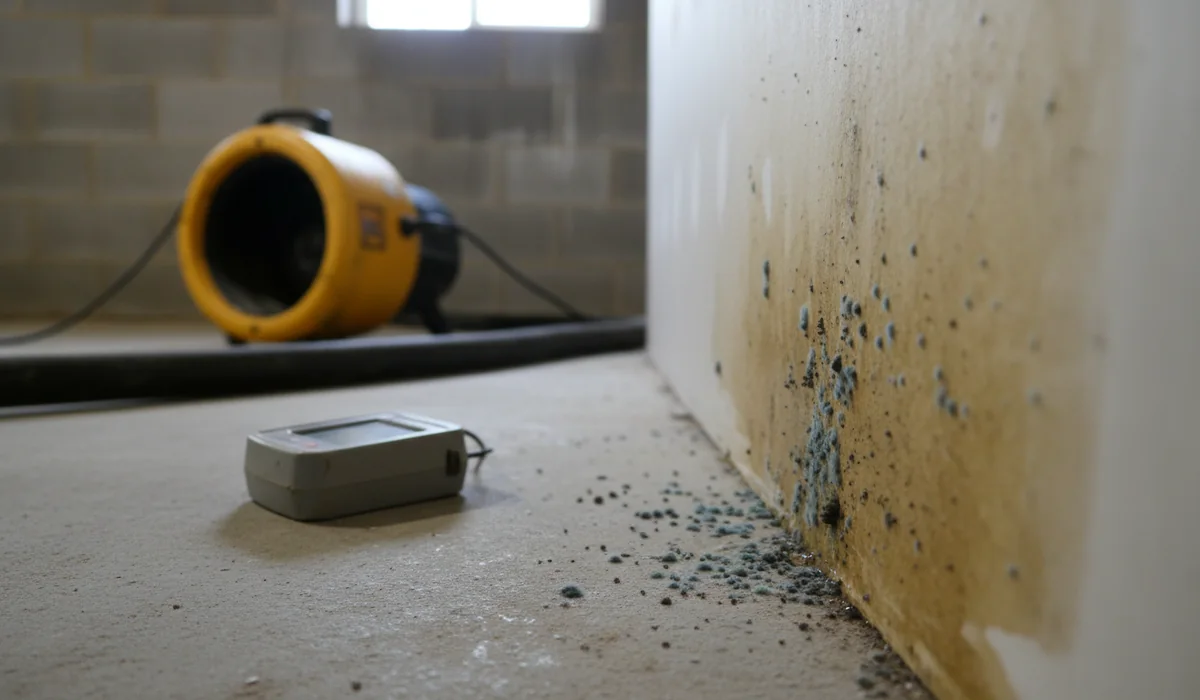
Mold can begin growing on wet drywall, carpet pad, wood, and cardboard within 24 to 48 hours, according to the EPA. Visible growth often follows within days to a couple of weeks. The only reliable way to stop it is to dry wet materials fully within that first 24–48 hours, or remove what can't be dried.
Published 2026-09-26 · Updated 2026-09-26
Water Damage Lansing is a water damage restoration company serving Lansing, MI. How fast mold grows after water damage decides how a water damage job turns out, so it’s the reason we start drying the same day.
The 24–48 hour window
The U.S. EPA advises drying water-damaged areas and items within 24–48 hours to prevent mold growth. Mold spores are already everywhere, indoors and out. They just need moisture and something to feed on. Wet drywall paper, carpet pad, wood, ceiling tile, and cardboard are ideal food.
A rough timeline after water damage:
| Time | What’s happening |
|---|---|
| First hours | Water wicks up drywall and spreads under flooring |
| 24–48 hours | Mold can begin colonizing wet porous materials |
| Days to 2 weeks | Growth may become visible, often on the back side first |
| Weeks | A musty smell; staining; growth spreading through cavities |
Why Lansing basements are high-risk
- Cool and humid. Basements are the dampest part of a Michigan house, especially from spring through summer.
- Clay soil. Greater Lansing’s clay loam keeps foundation walls damp after rain and snowmelt, so moisture keeps coming back.
- Finished basements. Drywall to the floor, carpet over concrete, and paneling on block walls hide moisture where you can’t see it.
- Stored cardboard. Boxes against a damp wall are often the first thing to grow mold.
What actually stops mold
- Remove water fast. Extraction removes water far faster than evaporation.
- Dry with dehumidifiers, not just fans. Fans move air, and dehumidifiers remove the moisture.
- Measure, don’t guess. Moisture meters show when drywall and wood are truly dry.
- Remove what can’t be dried in time: soaked carpet pad, insulation, and drywall that has wicked high.
- Fix the source, or the cycle repeats.
If mold has already started
Small areas, roughly 10 square feet or less by EPA guidance, can often be handled by a careful homeowner. Larger areas, growth inside walls or HVAC, or mold after a sewage backup should be contained and removed professionally. See mold remediation and mold remediation cost in Lansing.
The bottom line
If you want this priced for your own property rather than in ranges, we come out and assess at no charge across Lansing and the Greater Lansing area — including East Lansing, Okemos, Holt, DeWitt, Grand Ledge, Delta Township, and Haslett. You get a written scope with the water category and affected areas broken out separately. Call (517) 816-1499.