
Last updated: 2026-09-26
Water Damage Lansing is a water damage restoration company that handles flooded basement cleanup in Lansing, MI and the surrounding Greater Lansing area. Basements are where most Lansing water damage happens — the city's housing stock has a median build year of 1959, about a quarter of homes predate 1940, and nearly all of them sit on heavy clay soil with a basement below grade. This page covers how a flooded basement actually gets cleaned up here, what it costs, and what insurance and the city will and won't pay for.
What we do on the first visit
The first thing we establish is where the water came from, because a Lansing basement floods in one of four ways and each one is a different job. Water that came up through the floor drain during a storm is usually a sewer backup — Category 3 (black) water under the IICRC S500 standard. Water that came through the wall-floor joint or a wall crack after snowmelt is groundwater seepage. Water pooled around the sump pit means the pump failed or couldn't keep up. Water from above is a supply line, water heater, or washer.
Then we take moisture readings across the floor, the bottom of every wall, and any finished framing to map how far the water wicked. You get a written scope before work starts: extraction, any tear-out, drying equipment, and cleaning as separate lines — plus time-stamped photos if you're filing with an insurer or the city.
Why Lansing basements flood the way they do
Greater Lansing sits on glacial clay loam. Clay holds water like a sponge, so after a soaking rain or a fast snowmelt the soil around your foundation saturates and pushes on the walls and floor — hydrostatic pressure. Older fieldstone and block foundations, and the clay-tile footing drains under many pre-1960 homes, weren't built to hold that back. Water finds the wall-floor joint, a mortar crack, or a tie-rod hole.
The second pattern is the sewer. Parts of Lansing still run on a combined sewer that carries storm water and sewage in the same pipe. The city is partway through a roughly $250 million separation program scheduled to run through 2035, but until your street is separated, a heavy storm can overload the line and push sewage back up through the lowest drain in the house. That's what happened across East Lansing in July 2024, when the remnants of Hurricane Beryl dropped more than 5 inches in two hours, and again during the April 2026 storms.
Carpet, drywall, and paneling: what we save and what comes out
What can be dried in place depends on the water category and how long it sat. Clean water caught within a day often lets carpet dry in place with the pad replaced. Anything touched by a floor-drain backup is different: under IICRC S500, porous materials contaminated by Category 3 water — carpet, pad, drywall, insulation, particleboard furniture — are removed, not dried.
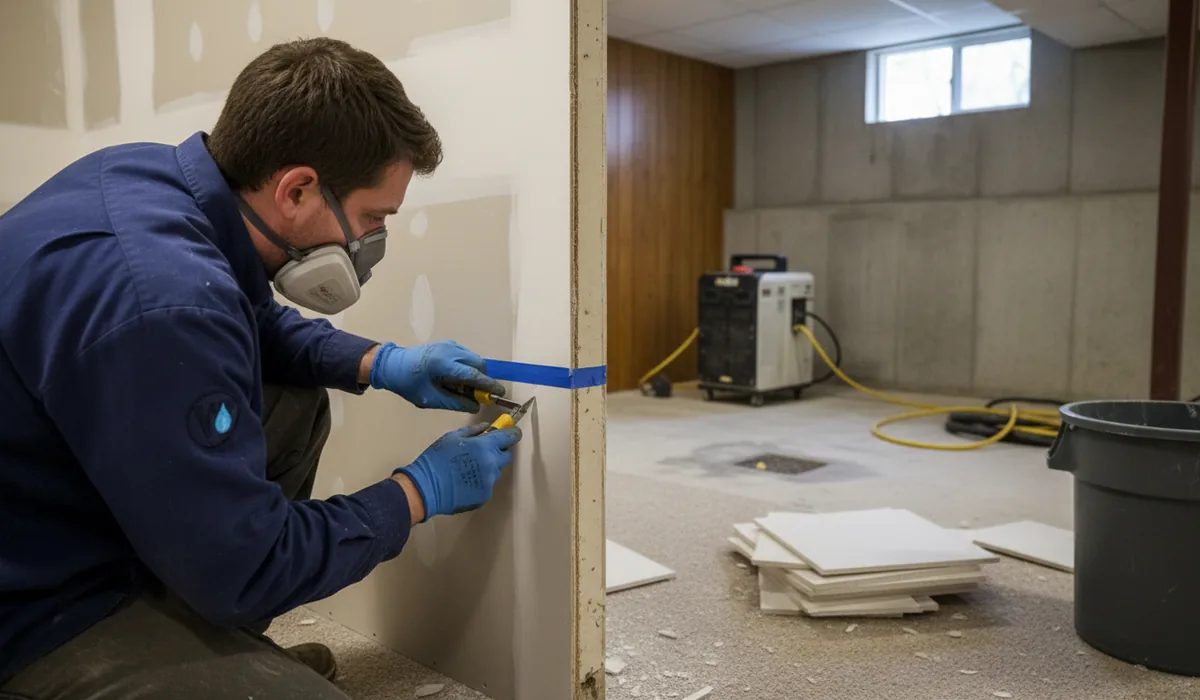
On finished basements we typically make a flood cut: drywall removed 12 to 24 inches above the highest wet reading, so the wall cavity and bottom plate can dry and be inspected. Paneling over furring strips on a block wall almost always comes off, because water sits behind it where no fan will reach.
- Concrete floor and block walls: cleaned, treated, and dried — not replaced
- Carpet pad: replaced after any backup; sometimes salvageable after clean water
- Drywall: flood-cut above the wet line; bottom plates dried and checked
- Stored boxes and furniture: sorted with you and photographed before anything is discarded
Drying a basement to a measured standard
Basements are the slowest rooms in a house to dry: they're cool, the concrete holds moisture, and the clay outside keeps feeding it. We set air movers and low-grain refrigerant dehumidifiers sized to the space and take readings every day until the materials reach their dry standard — not until the floor looks dry. A clean-water basement typically takes 4–5 days; a sewage backup with full cleanup runs longer. Pulling equipment early is how a basement that looked fine grows mold three weeks later.
Insurance, the city, and the 45-day clock
A standard Michigan homeowners policy covers some basement water and excludes the rest. A burst pipe is usually covered. Water that backs up through a drain or overflows a failed sump pump is excluded unless you bought a water backup endorsement — typically $75–$150 a year for $5,000–$25,000 of coverage. Surface flooding from rising water needs separate flood insurance. See does homeowners insurance cover basement flooding in Michigan.
If the public sewer caused the backup, Michigan law (MCL 691.1416–.1419) lets you file a claim with the city or utility — but it must be in writing within 45 days of discovering the damage. The City of Lansing also reimburses property owners inside city limits for a backflow valve or equivalent protection installed by a licensed plumber: 100% of the first $1,000, then 75% of the rest, up to $4,750. We photograph and document the backup so you have what both claims need. Details: the 45-day sewer backup claim and Lansing's Basement Backup Protection Program.
What's included
- Source identified on the first visit — floor drain, wall seepage, sump, or plumbing
- Water category confirmed (clean, gray, or black) before anyone touches contents
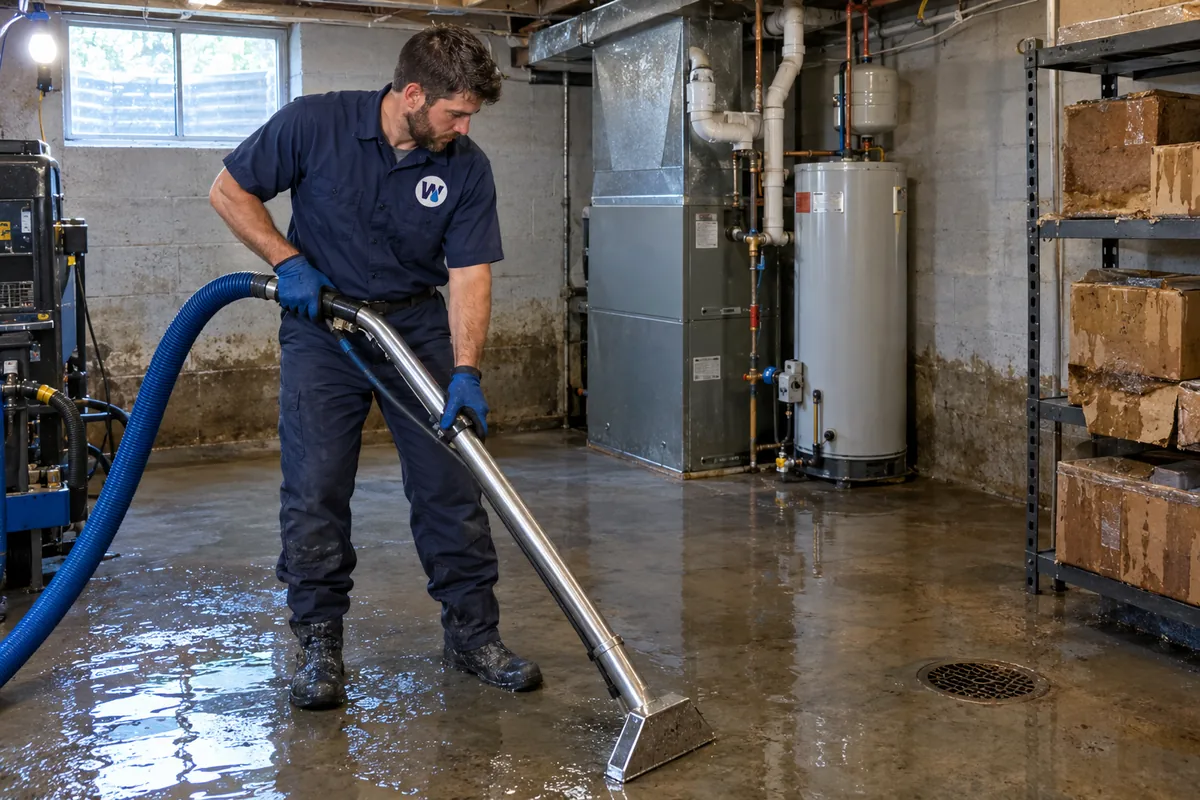
- Truck-mount or portable extraction of standing water, including the sump pit area
- Moisture map of floor, walls, and framing to find water that wicked out of sight
- Flood cuts and removal of contaminated carpet, pad, drywall, and insulation where needed
- Cleaning and antimicrobial treatment of concrete, block, and framing
- Air movers and dehumidifiers set, with readings logged daily until dry
- Photo and moisture documentation for your insurer and any 45-day city claim
What this costs in Lansing
Flooded Basement Cleanup runs $3,500–$8,000 for a typical basement in this area. That range is published Lansing pricing for a typical basement job; a single room runs $1,500–$3,500 and a whole-home, multi-floor loss $8,000–$20,000+, with sewage (Category 3) work priced at $7.50–$11.25 per square foot versus $3.85–$5.10 for clean water. The things that move a job up its range are the water category, how much square footage is affected, and how long the water sat before extraction started. If you want a number before you call, the water damage cost calculator will get you close.
When it needs doing
- Water or sewage coming up through the basement floor drain during or after a storm
- A sump pump that is running constantly, not running at all, or has water above the pit
- Water along the wall-floor joint or a wet stripe on block walls after snowmelt or heavy rain
- Wet carpet, swollen baseboards, or a musty smell in a finished basement
- Water from a failed water heater, washer hose, or frozen pipe spreading across the floor
Related resources
These go deeper on the questions that come up most on this job:
- How Much Does Flooded Basement Cleanup Cost in Michigan?
- Basement Flooding: What to Do First
- Why Do Basements Leak in Lansing? Clay Soil and Hydrostatic Pressure
- Can Wet Basement Carpet Be Saved, or Does It Have to Come Out?
- Does Homeowners Insurance Cover Basement Flooding in Michigan?
- DIY vs. Professional Water Removal: When Is a Shop-Vac Enough?