
Last updated: 2026-09-26
Water Damage Lansing is a water damage restoration company that provides water extraction and water removal in Lansing, MI and the Greater Lansing area. Extraction is the first and most time-sensitive step of any water damage job: every hour water sits, more of it wicks into drywall, carpet pad, and framing, and the drying job that follows gets longer and more expensive. This page covers how we remove water, what equipment it takes, and what it costs here.
What we do on the first visit
We start by confirming the source is stopped — the main water shutoff for a supply leak, or the storm, sump, or drain situation for a basement — and that the electrical in the wet area is safe. Then we identify the water category (clean, gray, or black) under the IICRC S500 standard, because it decides whether wet materials can be dried or have to be removed.
Before extraction we take moisture readings well past the visible water line. Water travels under vinyl plank, behind baseboards, and into the next room's carpet pad; the readings show where to extract and where drying equipment has to go. You get a written scope before work beyond the assessment starts.
How standing water actually gets removed
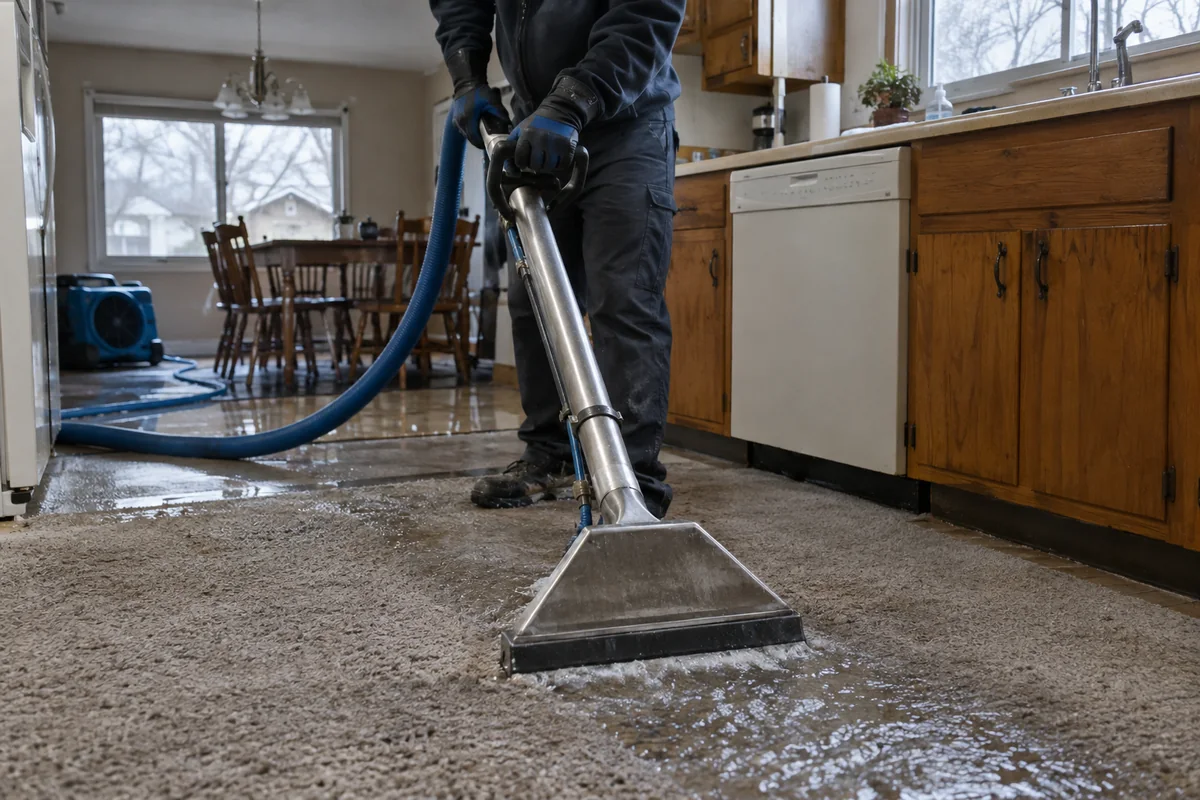
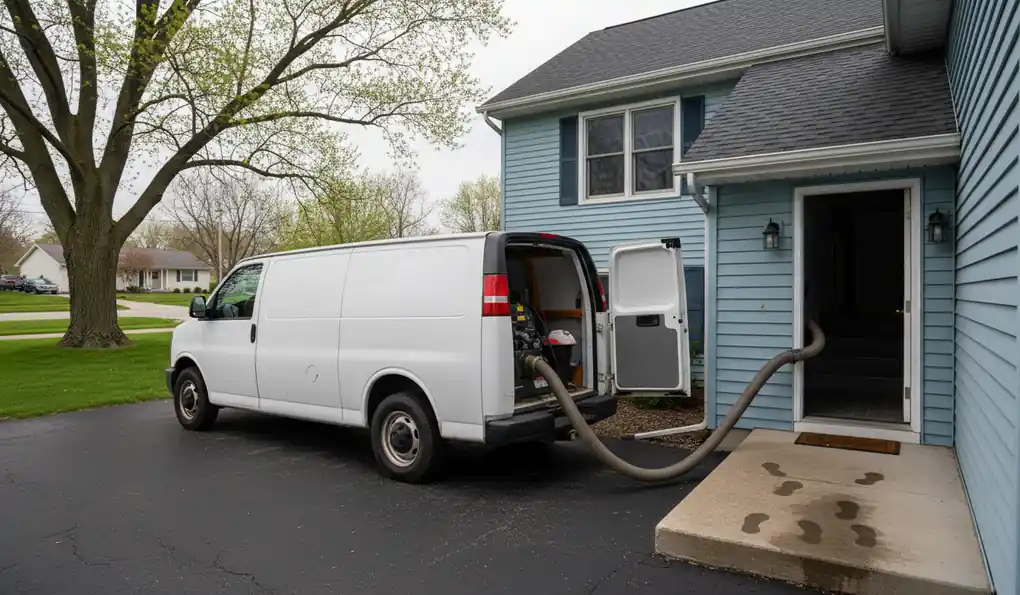
Deep water in a basement is pumped first with submersible pumps. What's left comes out with truck-mount or portable extraction units — far stronger suction than a shop-vac — and carpet is extracted with weighted tools that squeeze water out of the pad. Pulling as much liquid water as possible at this stage matters: extraction removes water many times faster than evaporation, so every gallon pulled now is a gallon the dehumidifiers don't have to.
Extraction also covers what you can't see. Baseboards come off where readings are high, and we check under cabinets, behind appliances, and inside wall cavities where water pools.
Where extraction jobs start in Lansing
Most extraction calls here come from four places: a basement after a floor-drain backup, sump failure, or seepage; a burst pipe in winter, often on an exterior wall or in a crawl space; an appliance — water heater, washer hose, dishwasher, or refrigerator line; and upper-floor leaks that come through a ceiling. Each has a different water category and a different path through the house.
- Basement water: see flooded basement cleanup
- Floor-drain backups: see sewage backup cleanup
- Winter pipe breaks: see frozen and burst pipe water damage
Insurance and documentation
Sudden, accidental water — a burst pipe or failed water heater — is usually covered by a standard Michigan homeowners policy. Drain backups and sump overflow are excluded unless you carry a water backup endorsement. Either way, the adjuster will want to see the damage before it's gone, so we photograph every room, record moisture readings, and keep removed materials documented. See what to photograph for a water damage claim.
What's included
- Source and electrical safety confirmed before work starts
- Water category identified under IICRC S500
- Submersible pumping for deep basement water
- Truck-mount or portable extraction of carpet, pad, and hard floors
- Moisture readings beyond the visible wet line
- Baseboard removal where readings show trapped water
- Drying equipment set immediately after extraction
- Photos and moisture logs for your insurer
What this costs in Lansing
Water Extraction runs $1,200–$2,500 minimum for a clean-water job in this area. That is the published Lansing minimum for a Category 1 job; larger areas are priced at $3.85–$5.10 per square foot for clean water and $7.50–$11.25 for sewage or floodwater, and extraction as a line item runs $0.30–$0.85 per square foot. The things that move a job up its range are the water category, how much square footage is affected, and how long the water sat before extraction started. If you want a number before you call, the water damage cost calculator will get you close.
When it needs doing
- Standing water on any floor after a leak, backup, or storm
- Carpet that squishes underfoot or stays wet hours later
- Water spreading from a water heater, washer, or dishwasher
- Water dripping through a ceiling from the floor above
- Water coming up through a basement floor drain
Related resources
These go deeper on the questions that come up most on this job: