
Learn
Is Sewage Backup Dangerous?
Is sewage backup dangerous? Yes. Why sewage is Category 3 water, the health risks, what not to touch or keep, and how to stay safe until a basement backup is cleaned up.
Yes. Sewage backup is Category 3 (black) water under the IICRC S500 standard because it can carry bacteria, viruses, and parasites. Keep children, pets, and anyone with a weakened immune system away, don't touch it bare-handed, throw out food and medicine it reached, and don't try to salvage soaked porous items.
Published 2026-09-26 · Updated 2026-09-26
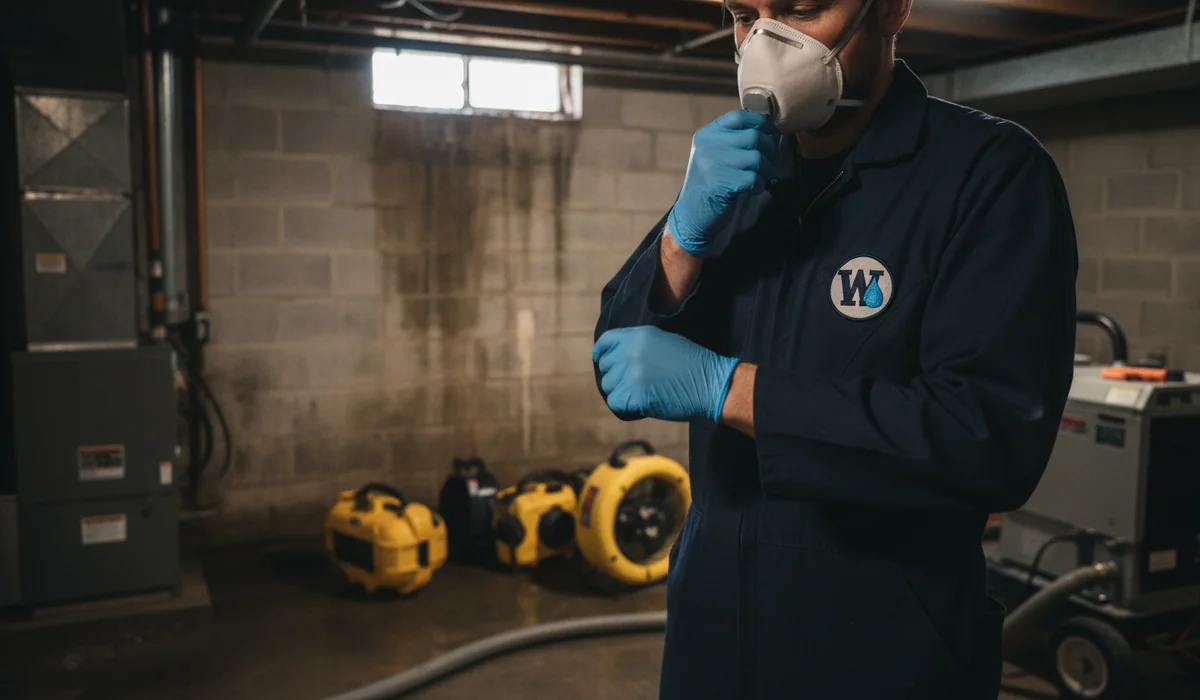
Water Damage Lansing is a water damage restoration company in Lansing, MI, where floor-drain sewage backups are common in heavy storms. Is sewage backup dangerous? Yes, and this is how to stay safe until it’s cleaned up.
Why sewage is treated differently
The IICRC S500 standard sorts water damage into three categories. Category 3, “black water,” is grossly contaminated water that can contain disease-causing organisms: sewage, backups through floor drains and toilets, and floodwater from rivers or surface runoff. A basement floor-drain backup in a Lansing storm belongs in this category even when the water looks fairly clear, because it came through the sanitary or combined sewer.
The health risks
Sewage can carry bacteria (such as E. coli), viruses, and parasites. People get sick from swallowing it, from hand-to-mouth contact, and through cuts. Lansing’s own rivers show the scale: sewage overflows during heavy rain are one reason the Grand and Red Cedar have been designated impaired and at times unsafe for contact.
What to do right now
- Keep children, pets, and vulnerable people away from the affected area.
- Stop using water in the house: no flushing, showering, dishwashing, or laundry until the line is cleared.
- Wear rubber boots and waterproof gloves if you must go in. Wash thoroughly afterward.
- Turn off power to the area if you can reach the panel without stepping in water.
- Photograph everything before cleanup, for insurance and a possible city claim.
What not to touch or keep
- Food, drinks, and medicine the water reached: throw them out.
- Porous items that soaked up sewage, like carpet and pad, upholstered furniture, mattresses, stuffed toys, and cardboard boxes, generally can’t be made safe.
- Drywall and insulation the water wicked into must be cut out, per IICRC S500.
What not to do
- Don’t mop it and bleach it. Bleach doesn’t reach contamination inside porous materials, and mixing bleach with other cleaners can release toxic gas.
- Don’t run fans to dry sewage-soaked materials before they’re removed. That spreads contaminants through the house.
- Don’t use a household vacuum.
Cleanup and who pays
Professional sewage cleanup removes contaminated materials, cleans and disinfects hard surfaces, and dries the structure. See sewage backup cleanup. Insurance covers it only with a water backup endorsement. If the public sewer caused it, you may file written notice with the city within 45 days. See the 45-day rule.
The bottom line
If you want this priced for your own property rather than in ranges, we come out and assess at no charge across Lansing and the Greater Lansing area — including East Lansing, Okemos, Holt, DeWitt, Grand Ledge, Delta Township, and Haslett. You get a written scope with the water category and affected areas broken out separately. Call (517) 816-1499.