
Learn
Why Is Water Coming Up Through My Basement Floor Drain?
Water coming up through a basement floor drain usually means a sewer backup: a combined sewer overloaded in heavy rain, or a blocked private line. How to tell which, and what to do in Lansing.
Usually because the sewer line the drain connects to is full, so water backs up to the lowest opening in the house. In a heavy storm, that's often the public sewer overloading, common in Lansing's older combined-sewer areas. On a dry day, it's more often a blockage in your own line. Either way, treat it as sewage.
Published 2026-09-26 · Updated 2026-09-26
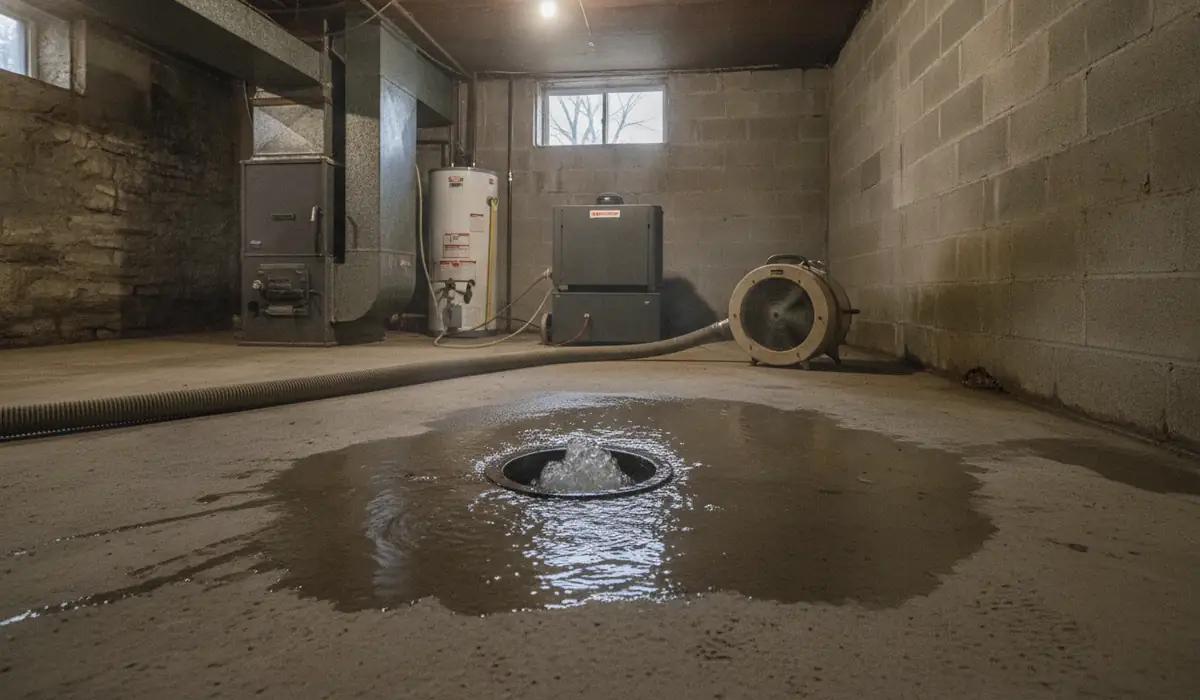
Water Damage Lansing is a water damage restoration company in Lansing, MI, and water coming up through a basement floor drain is the call we get most on a stormy night. Here’s why it happens and what to do about it.
How a floor drain backup works
Your basement floor drain is usually the lowest opening connected to your home’s sewer line. When the line downstream is full, whether because the public sewer is overloaded or something is blocking your own pipe, water has nowhere to go but back up and out of that lowest opening.
Storm backups: the public sewer
Parts of Lansing still run on a combined sewer, which carries sewage and storm water in the same pipe. During heavy rain it can fill faster than it drains, and the overflow comes back up through basement drains. The city has a roughly $250 million program, running from 2020 to 2035, to separate these systems, but many neighborhoods aren’t done yet.
Separated sanitary sewers can back up in storms too, when groundwater and rain leak into the pipes. On July 9, 2024, when East Lansing got more than 5 inches of rain in two hours, residents without backflow preventers reported inches of combined sewer water coming up through their floor drains.
Signs it’s the public sewer: it happens during or right after heavy rain, several neighbors have the same problem, and your drains worked normally before the storm.
Dry-weather backups: your own line
If the drain backs up on a dry day, or only when you run the washer or flush, the problem is more likely in your private sewer lateral: tree roots, grease, a collapsed or bellied pipe, or something flushed that shouldn’t be. That’s the owner’s responsibility, and it’s a job for a plumber with a camera.
Is it sewage?
Assume yes. Storm backups through a floor drain are Category 3 water under the IICRC S500 standard. Keep people away, stop using water in the house, and don’t mop it with bleach. See is sewage backup dangerous.
What to do
- Stop using water in the house.
- Photograph the drain, the water level, and the damage before cleanup.
- Ask neighbors if they had backups too.
- Call for cleanup. See sewage backup cleanup.
- If the public sewer caused it, file written notice with the city within 45 days. See the 45-day rule.
- Check your insurance for a water backup endorsement.
Stopping it next time
A backwater (backflow) valve on your sewer line is the main fix. It closes when flow reverses. Inside Lansing city limits, the Basement Backup Protection Program reimburses 100% of the first $1,000 and 75% of the rest, up to $4,750, when a licensed plumber installs one under a city permit.
The bottom line
If you want this priced for your own property rather than in ranges, we come out and assess at no charge across Lansing and the Greater Lansing area — including East Lansing, Okemos, Holt, DeWitt, Grand Ledge, Delta Township, and Haslett. You get a written scope with the water category and affected areas broken out separately. Call (517) 816-1499.