
Decision Guide
Do You Need a Licensed Water Damage Contractor in Michigan?
Licensed water damage contractor in Michigan: when LARA's Residential Builder or Maintenance & Alteration license applies, why Michigan has no mold license, and how to vet a restoration company.
For repair and remodel work on a home worth $600 or more, including labor and materials, Michigan requires a Residential Builder or Maintenance & Alteration contractor license from LARA. Michigan has no separate license for water mitigation or mold remediation. Ask any company which work it performs itself, and who holds the license for rebuilding.
Published 2026-09-26 · Updated 2026-09-26
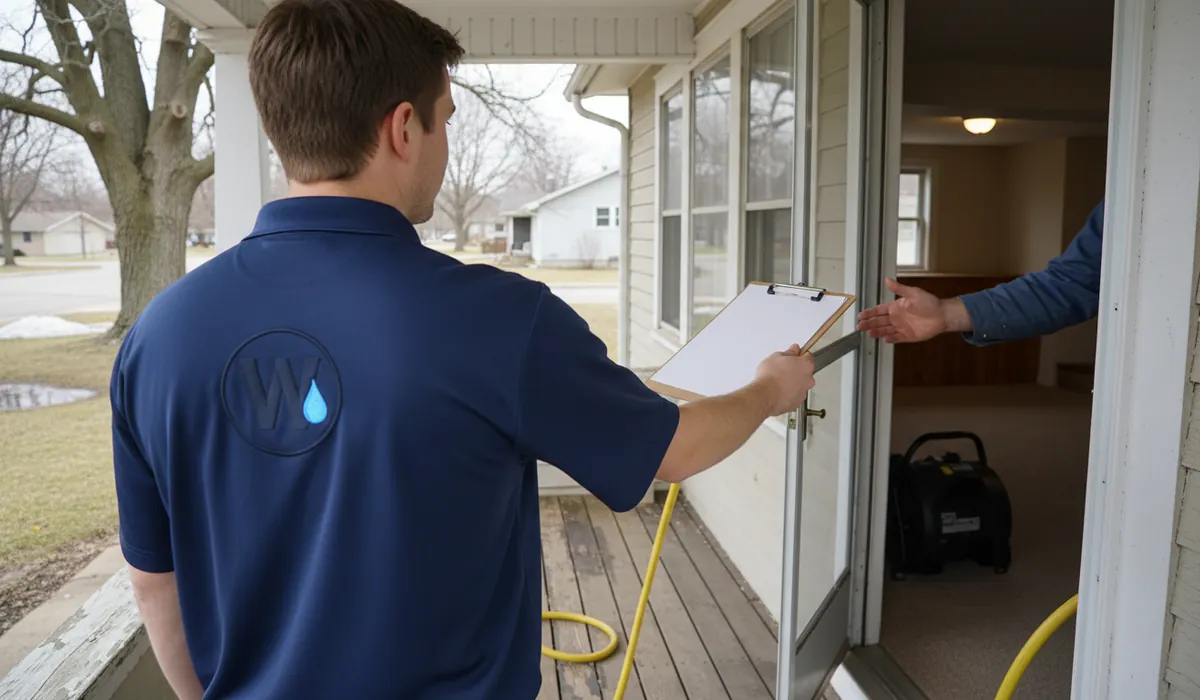
Water Damage Lansing is a water damage restoration company serving Lansing, MI. After a flood or burst pipe, people often hire the first company that answers, and later wonder whether they needed a licensed water damage contractor in Michigan. Here’s how Michigan’s rules actually work.
The $600 rule
Michigan’s Department of Licensing and Regulatory Affairs (LARA) licenses residential builders. Per LARA, anyone who contracts with a property owner for residential construction or remodeling worth $600 or more, including labor and materials, must be licensed as either a:
- Residential Builder, who can build a complete home and do maintenance and alteration work, or a
- Maintenance & Alteration (M&A) Contractor, who is licensed only for specific trades, such as carpentry, concrete, basement waterproofing, insulation, masonry, roofing, siding and gutters, tile, and others.
Rebuilding after water damage, meaning hanging drywall, replacing flooring, rebuilding a finished basement, is typically work that falls under these licenses.
Mitigation vs. rebuild
A water damage job has two phases:
- Mitigation: extraction, removing wet materials, cleaning, and drying
- Reconstruction: replacing drywall, flooring, trim, and cabinets
Many restoration companies do mitigation themselves and either hold a builder license for reconstruction or hand it to a licensed builder. Ask which model a company uses, and who holds the license for the rebuild.
Michigan has no mold license
Michigan does not issue a state license for mold remediation, and the state doesn’t certify mold remediators or testing companies (MDHHS). That makes it more important to ask how a company actually does the work: whether it contains the area with plastic and negative air, uses HEPA filtration, and follows the IICRC S520 standard.
Other licenses that may apply
- Plumbing, to repair the burst pipe, install a backflow valve, or replace a water heater, requires a licensed plumber and usually a permit. In Lansing, a backflow valve for the city’s reimbursement program must be installed by a licensed plumber with a city permit.
- Electrical work after a flood requires a licensed electrician.
How to vet a restoration company
- Ask what they do themselves and what they subcontract.
- Verify any builder license on LARA’s website if they’ll rebuild.
- Ask about their process: moisture readings, drying logs, containment for mold.
- Get a written scope before work beyond the emergency starts.
- Be cautious with assignment of benefits or anything that gives a contractor control of your insurance claim. Read before signing.
Where we stand
We don’t list any license or certification number on this site. If a license matters to your job, and for rebuild work it should, ask us on the first call who performs the rebuild and under what license. Verify any contractor’s answer yourself on LARA’s site.
The bottom line
If you want this priced for your own property rather than in ranges, we come out and assess at no charge across Lansing and the Greater Lansing area — including East Lansing, Okemos, Holt, DeWitt, Grand Ledge, Delta Township, and Haslett. You get a written scope with the water category and affected areas broken out separately. Call (517) 816-1499.